
Why Smart Candidates Keep Getting Rejected (And It's Not Your Skills)
Thu, Jan 29, 2026
You've got the skills. You've built projects, solved real problems, maybe even taught yourself entire domains from scratch. Yet your applications vanish into silence. Interviews lead nowhere. And slowly, a question starts gnawing: Am I actually not good enough?
Here's the truth most hiring systems won't tell you: Your rejections probably have nothing to do with your ability. They're signal failures, not skill failures. Modern hiring operates as a risk-filtering machine optimized to eliminate uncertainty, not discover potential. And if your background doesn't broadcast "safe bet" in the exact format systems expect, you get filtered out before anyone assesses what you can actually do.
This isn't about resume formatting tips or interview tricks. It's about understanding why capable people get systematically overlooked, and what's changing to fix it.
The System Isn't Designed to Find You
Corporate hiring processes aren't built to discover hidden talent. They're built to avoid bad hires. And there's a massive difference.
A bad hire costs anywhere from 30% of first-year salary to five times annual compensation when you factor in lost productivity, team disruption, and replacement costs. For a $100,000 role, that's potentially a $500,000 mistake. Hiring managers know this. Their incentive structure rewards caution over discovery.
The result? Hiring becomes a knockout tournament, not a talent search. Each stage exists to eliminate risk, not surface capability. Ambiguity on your resume? Gone. Nonlinear career path? Risky. Unconventional background? Why take the chance when there are "safer" candidates available?
Research from Lauren Rivera at Kellogg School of Management found that elite firms systematically favor candidates from privileged backgrounds not through intentional discrimination, but by defining "merit" in ways closely tied to social class. Hiring teams look for accomplishments, activities, and communication styles that require significant time and resource investment, the kind that come easier to those already advantaged.
This isn't malice. It's structural risk aversion playing out across thousands of daily decisions. And it means strong candidates with nontraditional paths get filtered out not because they lack ability, but because their signal doesn't match the system's narrow definition of "qualified."
The Resume Black Hole Is Real (But Not How You Think)
If you've sent out dozens of applications and heard nothing back, you've experienced what candidates call the "resume black hole." The common explanation? Applicant Tracking Systems (ATS) automatically reject 75% of resumes before humans see them.
That stat gets repeated constantly. It's also misleading.
Recent research from Enhancv interviewed 25 recruiters across industries and found that only 8% configure their ATS to auto-reject based on content. The other 92% reject manually or use basic compliance filters (work authorization, required certifications). The ATS doesn't reject you. It organizes applications so humans can process volume. The real problem is what happens next.
A typical corporate job posting attracts around 250 applications. Maybe 4-6 candidates get interviews. The math is brutal, and it gets worse: 98% of Fortune 500 companies use ATS software, but the bottleneck isn't the technology. It's human capacity operating under time pressure.
Recruiters screen hundreds of resumes looking for quick signals of fit. They're not deeply analyzing your potential. They're pattern matching against mental checklists: right job titles, recognizable companies, expected keywords, conventional career progression. If your background requires interpretation or context to understand its value, it often doesn't get that chance.
This is where capable candidates with unconventional paths get lost. Not because an algorithm rejected them, but because human screeners under cognitive load default to easily recognizable patterns. You're not making it past human judgment operating at scale, and that judgment favors clarity over depth.
When Pedigree Becomes Proxy for Potential
The most insidious filter isn't technical. It's pedigree bias masquerading as quality standards.
Matched resume studies (where researchers send identical resumes with only one variable changed) consistently demonstrate systematic bias. The landmark Bertrand and Mullainathan study found that resumes with traditionally white names like "Emily" and "Greg" received 50% more callbacks than identical resumes with names like "Lakisha" and "Jamal." That's equivalent to about eight additional years of experience needed to compensate for a name signal alone.
Rivera's research on class signals in hiring found similar patterns. Law firms were less likely to hire candidates whose hobbies included "country music" and "pickup soccer" versus "classical music" and "sailing," even with identical work experience. The content of leisure activities signaled class background, which hiring teams unconsciously used as a proxy for fit.
For candidates without elite credentials, this creates a catch-22. LinkedIn data shows that skills-first hiring approaches can expand qualified talent pools by 15.9× compared to pedigree-first methods. That means companies are overlooking strong candidates at massive scale simply because they filter for brand names rather than demonstrated ability.
Major tech companies have started acknowledging this. Google, IBM, and others dropped degree requirements for many roles, recognizing that educational pedigree predicts credentials, not capability. IBM removed degree requirements from over half its U.S. job postings as of 2021. But most organizations haven't caught up. They still use proxies (degrees, company names, linear career paths) as shorthand for quality, systematically screening out talent that doesn't fit the conventional template.
Career Gaps and Nonlinear Paths Trigger Bias
If your resume shows gaps or career switches, you face another layer of systematic disadvantage. Research published in Nature Human Behaviour found that employers discriminate significantly against candidates with employment gaps, even when those gaps are explained or involve caregiving.
The study tested over 9,000 applications and found something remarkable: Simply listing years of experience (5 years) instead of employment dates (March 2018–March 2023) increased call backs by approximately 15% for candidates with gaps. The content was identical. The only difference was whether gaps were visible or obscured by how information was framed.
This isn't a rational evaluation. It's a pattern-based risk assessment. Hiring teams see a gap and assume reduced capability, lack of commitment, or skill decay, even when evidence suggests otherwise. The bias is particularly severe for women with caregiving-related breaks, contributing to persistent wage gaps and underrepresentation in leadership.
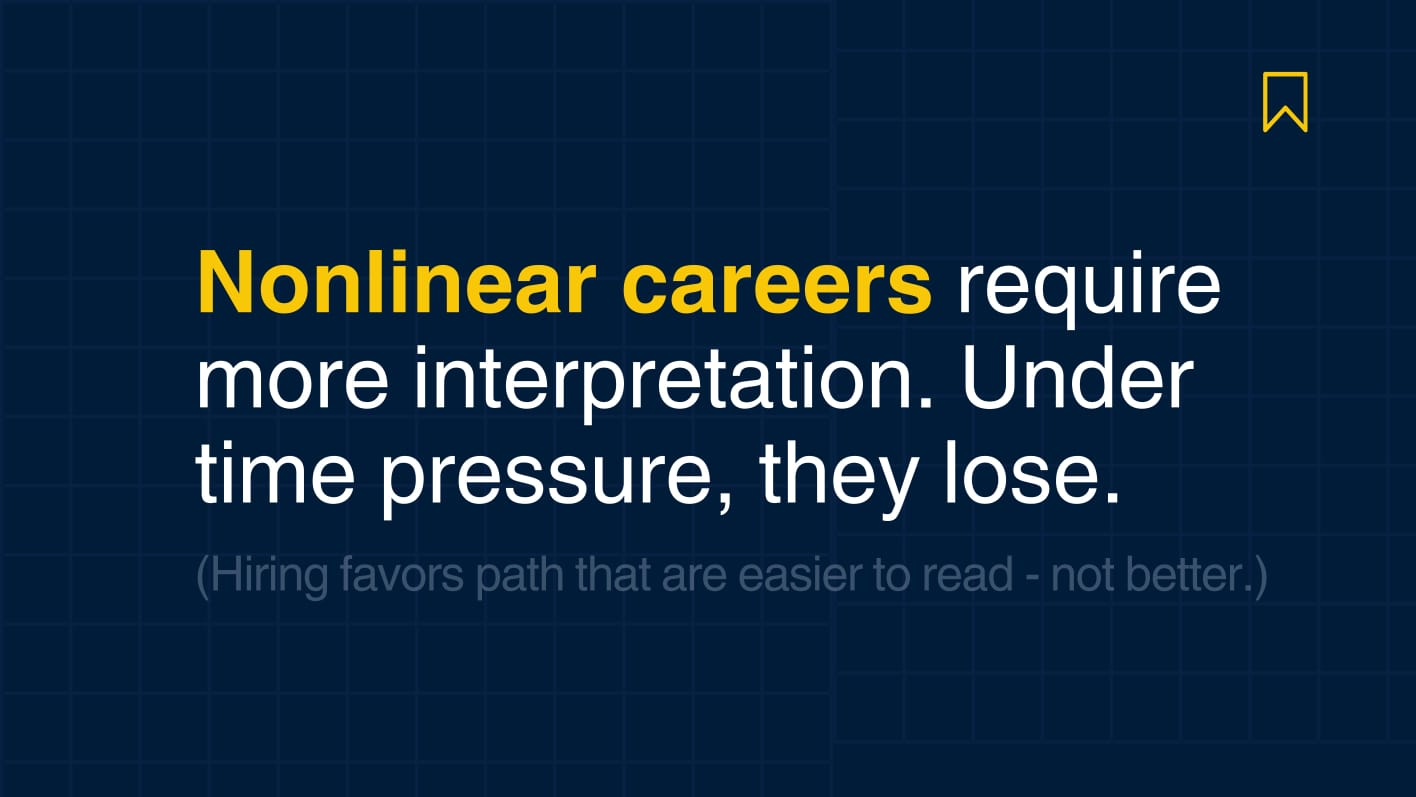
Nonlinear careers face similar penalties. Career switchers, late bloomers, and cross-domain talent often send "noisy" signals that don't map cleanly to standard role expectations. A data scientist who started in journalism, a developer who worked in finance first, a product manager with an engineering PhD—these backgrounds bring valuable perspective but require more cognitive effort to evaluate. Under time pressure, evaluators default to conventional paths that require less interpretation.
Interviews Rarely Rescue Overlooked Talent
You might think interviews offer a chance to overcome resume bias. If you can just get in the room, you can prove yourself, right?
Research suggests otherwise. Interviews don't typically uncover hidden value. They reinforce pre-formed impressions.
Unstructured interviews (where interviewers ask whatever comes to mind) correlate only 0.38 with job performance according to Schmidt and Hunter's meta-analysis. That's barely better than chance. Structured interviews, where every candidate answers identical behavioral questions, improve to 0.51 correlation. But here's the problem: most companies don't use structured interviews consistently.
Recent SIOP research found that structured interviews may actually be the strongest predictor of job performance (0.42 operational validity), even surpassing cognitive ability tests. But implementing them requires discipline most organizations lack. Instead, interviews become conversational assessments heavily influenced by cognitive biases.
Confirmation bias means interviewers look for evidence supporting their initial impression from your resume. Affinity bias means they favor candidates similar to themselves. Halo effects mean one impressive answer colors perception of everything else. And only 20% of companies train interviewers to evaluate equitably, according to LinkedIn's Global Talent Trends Report.
For candidates already disadvantaged by resume screening, interviews often cement rather than challenge those initial judgments. The conversation starts from a position of doubt rather than genuine curiosity about capability.
What Actually Predicts Performance
Here's where it gets interesting. The things hiring systems overweight (years of experience, education level, unstructured interviews) are weak predictors of job performance. Meanwhile, the methods that actually work get underused.
Schmidt and Hunter's research (updated by Sackett et al. in 2022) reveals the hierarchy clearly:
The gap isn't subtle. Demonstrated ability through work samples and assessments predicts performance 3-5× better than the credentials most hiring processes prioritize.
Yet most companies still lean heavily on resumes and informal interviews because they're familiar, not because they work. The evidence has been clear for decades. Implementation remains rare.
This creates an opportunity. If you can demonstrate actual capability through validated assessments rather than relying on resume signals alone, you bypass the filters that eliminate strong candidates with unconventional backgrounds.
Assessments as Signal Amplifiers
Well-designed assessments level the playing field in ways resumes never can. When every candidate faces identical challenges measured against consistent criteria, demonstrated ability becomes impossible to ignore.
This isn't theoretical. Unilever eliminated resume-based screening for early-career hiring in favor of game-based assessments evaluating cognitive ability and job-relevant behaviors. The results: Applications doubled, time-to-hire dropped from four months to four weeks, and workforce diversity increased 16%. They weren't lowering standards. They were measuring what actually mattered.
The key is comprehensiveness. Single-dimension tests (a coding quiz, a personality inventory) capture only part of the picture. High-performing candidates are multidimensional. Your value isn't a single score.
A 360° assessment approach evaluates across multiple critical dimensions: cognitive ability, technical skills, problem-solving under pressure, communication effectiveness, behavioral patterns. This creates a rich profile of capability that transcends what any resume could convey.
For candidates with strong skills but weak pedigree signals, comprehensive assessments become your voice. Instead of hoping a hiring manager infers your potential from bullet points, you demonstrate it directly through performance on tasks similar to the actual work. The assessment becomes evidence, not speculation.
iqigai's platform operationalizes this approach specifically for tech and AI talent. Rather than screening by resume, candidates complete validated 360° assessments covering technical competency, cognitive ability, and behavioral fit. The system uses AI proctoring to ensure integrity while generating comprehensive capability profiles that employers can trust.
Think of it as proving what you can do before anyone judges where you've been. Your assessment performance becomes the signal, bypassing traditional filters entirely.
From Filtering to Discovery
The traditional hiring model optimizes for one thing: eliminating candidates efficiently. It's a filtering system, not a discovery system. And filtering systems favor easily recognized patterns over hidden potential.
What's emerging is different. Platforms like iqigai function as discovery infrastructure, designed specifically to surface under-recognized talent.
Here's how it works: You complete a comprehensive assessment once. That assessment generates a detailed capability profile capturing your cognitive ability, technical skills, domain knowledge, and behavioral patterns. This profile then gets matched via AI algorithms against hundreds of roles in iqigai's network.
Instead of manually applying to dozens of positions hoping someone notices you, you get discovered by employers specifically looking for your demonstrated capabilities. The entire process inverts. Rather than proving you're not a risk, you show what you can do, and employers come to you.
Critically, iqigai's philosophy is explicitly skills-first. "No fancy tag? No problem. We favor skills over pedigree." The platform is designed to be blind to conventional status markers. What matters is how you perform on validated challenges, not what school you attended or which companies employed you previously.
For recruiters, this de-risks hiring. Candidates on their shortlist arrive pre-vetted by objective assessment data, not just resume claims. For candidates with strong abilities but weak traditional signals, it creates pathways that didn't exist before.
The assessment acts as infrastructure connecting capability to opportunity without forcing either side through broken filtering mechanisms.
The Market Is Shifting (Slowly)
Change is happening, but it's uneven. Forward-thinking organizations recognize that credential-based filtering wastes talent. Skills-based approaches demonstrably expand quality talent pools while improving diversity and retention.
But momentum fights inertia. Most hiring teams still default to familiar patterns: scan resumes for recognizable names, filter by keywords, interview based on gut feel. Changing this requires infrastructure, not just intention.
Assessment platforms, blind resume screening, structured interview frameworks—these aren't nice-to-haves anymore. They're how organizations serious about talent actually find it. Companies that adopt evidence-based selection see measurable improvements: 50-75% faster hiring, 10-15% lower early attrition, 2-3× recruiter efficiency gains.
For candidates, this means opportunity is bifurcating. Traditional companies still filter by pedigree. You can keep sending resumes into that system and hoping someone notices, or you can engage with platforms and employers that evaluate differently.
What This Means for You
If you're skilled but repeatedly rejected, the problem probably isn't your capability. It's that your signal doesn't match what broken filtering systems recognize.
You have three options:
1. Keep playing the traditional game. Apply to hundreds of positions, optimize resume keywords, hope someone looks past the surface. This works sometimes, but it's grinding against structural disadvantages.
2. Build stronger conventional signals. Get the brand-name credentials, the recognizable company experience, the linear career progression. This works if you have time and resources. Most don't.
3. Change the signal entirely. Demonstrate capability through validated assessments that bypass traditional filters. Show what you can do before anyone judges where you've been.
The third path is newer, but it's also the only one that addresses the core problem: hiring systems evaluate signals, not people. If your signals are weak but your skills are strong, you need a different way to be seen.
iqigai exists specifically for this. Take comprehensive assessments, generate capability profiles, get matched to employers looking for demonstrated ability rather than pedigree. It's not magic. Its infrastructure is designed around evidence rather than proxies.
The system isn't going to start valuing you differently. But you can change which system you engage with.
Bottom Line
Rejection isn't personal, even when it feels that way. It's systematic. Hiring operates as a risk-filtering machine, and anything that requires interpretation gets filtered out under time pressure. Unconventional backgrounds, career gaps, nonlinear paths, missing credentials—these trigger caution, not because they indicate inability, but because they increase perceived uncertainty.
The data is clear: Traditional screening methods barely predict performance. Demonstrated ability through validated assessments predicts it dramatically better. Yet most hiring still defaults to weak signals because they're familiar.
That gap is an opportunity. Organizations building infrastructure around evidence-based selection find better talent faster. Candidates with strong skills but weak traditional signals find pathways that previously didn't exist.
You're not getting rejected because you lack ability. You're getting rejected because the signal-processing system can't recognize what you have. Fix the signal, and the rejections stop being a referendum on your capability. They become noise you can route around entirely.
Ready to prove what you can do? Take iqigai's 360° assessment and let employers discover your capability directly.