
8 Misconceptions About AI in Hiring That Are Costing You Talent
Wed, Feb 18, 2026
AI Adoption Has Outpaced AI Understanding
If your boardroom conversations about AI in hiring still sound like a mix of hype, fear, and vendor demos, you're not alone.
Here's the paradox: 43% of organizations used AI for HR and recruiting in 2025 according to research on AI adoption in the future of work, up from just 26% in 2024—a 96% year-over-year spike. Meanwhile, 66% of U.S. adults say they would avoid applying for jobs that use AI in hiring. We're deploying faster than we're understanding, and the gap shows.
That rapid adoption hasn't translated into clarity. Senior leaders often conflate automation with judgment, neutrality with fairness, and speed with better outcomes. This results in inconsistent implementations, wasted spend, compliance exposure, and talent that walks away before you ever see them.
This article unpacks eight persistent myths about AI hiring and what the data actually shows. No hype, no vendor pitches. Just evidence-backed corrections and practical implications for leaders making defensible decisions.
1. "AI Will Replace Recruiters and Hiring Managers"
The fear is understandable. If AI can screen thousands of resumes in seconds, what's left for recruiters to do?
AI handles up to 40% of repetitive tasks in recruiting, reflecting the broader shift highlighted in AI’s evolving role in recruitment and retention. Meanwhile, 96% of U.S. hiring professionals who use AI say it helps identify strong candidates rather than replacing human decision-making. The work isn’t disappearing — it’s shifting.
Only 31% of recruiters allow AI to make final hiring decisions autonomously, and that figure drops even further for senior or specialized roles. Hiring decisions involve accountability, context, and trade-offs. Enterprises aren't willing to hand over outcomes when reputational, legal, and cultural stakes are this high.
What's changing is where recruiters spend their time. 86.1% of recruiters report that AI makes hiring faster, not more automated. They're spending less time on manual resume screening and interview scheduling, and more on stakeholder alignment, refining hiring criteria, and making better-informed final evaluations.
The shift isn't job replacement but more like role evolution. Recruiters are moving from administrators to strategists — a shift aligned with research on unlocking AI’s full potential at work.
AI is a force multiplier, not a headcount reducer. If more than 40% of your recruiting team's time goes to tasks AI could automate, you're leaving strategic value on the table. The question isn't whether AI replaces recruiters; it's whether you're redeploying their capacity toward higher-value work like employer branding, candidate experience design, and hiring manager partnership.
2. "AI Makes Hiring Objective and Bias-Free by Default"
The logic says: algorithms don't have prejudices, so they must be fairer than humans. Unfortunately, objectivity doesn't emerge automatically from code.
The reality is more complicated. Mobley v. Workday was certified as a collective action in May 2025, potentially affecting 1 billion applications processed through the platform. Harper v. Sirius XM was filed in August 2025, alleging racial discrimination through AI screening. These cases aren’t theoretical. They reflect growing concerns about real-world risks of biased AI recruiting tools.
The academic research is equally sobering. A Stanford study from February 2025 found that AI resume tools gave older male candidates higher ratings than female candidates and young candidates with identical credentials. This occurs because AI systems learn from historical data, which often reflects existing organizational biases. If your past "successful hires" skewed toward certain demographics, the algorithm will optimize for those patterns, not because it's discriminatory by design, but because it's trained to replicate past outcomes.
This doesn't mean AI is ineffective at reducing bias. When designed well with diverse training data, fairness constraints, and active monitoring, AI can reduce human inconsistency and shift evaluations toward skills and performance signals. But fairness doesn't emerge by default. It requires intentional design, ongoing governance, and human oversight with real authority to intervene.
You remain legally liable regardless of whose tool you use. Conduct a demand bias audit with vendors before making a purchase. Implement quarterly internal audits analyzing outcomes by protected categories. Document your human oversight processes. Budget for legal compliance; it's cheaper than settlements. One Fortune 500 company paid $2.275 million in an AI discrimination settlement in 2024, and that's before the current wave of litigation fully plays out.
3. "AI Hiring Is Cold and Damages Candidate Experience"
Many leaders worry that automation makes hiring impersonal and off-putting. The data tells a more nuanced story.
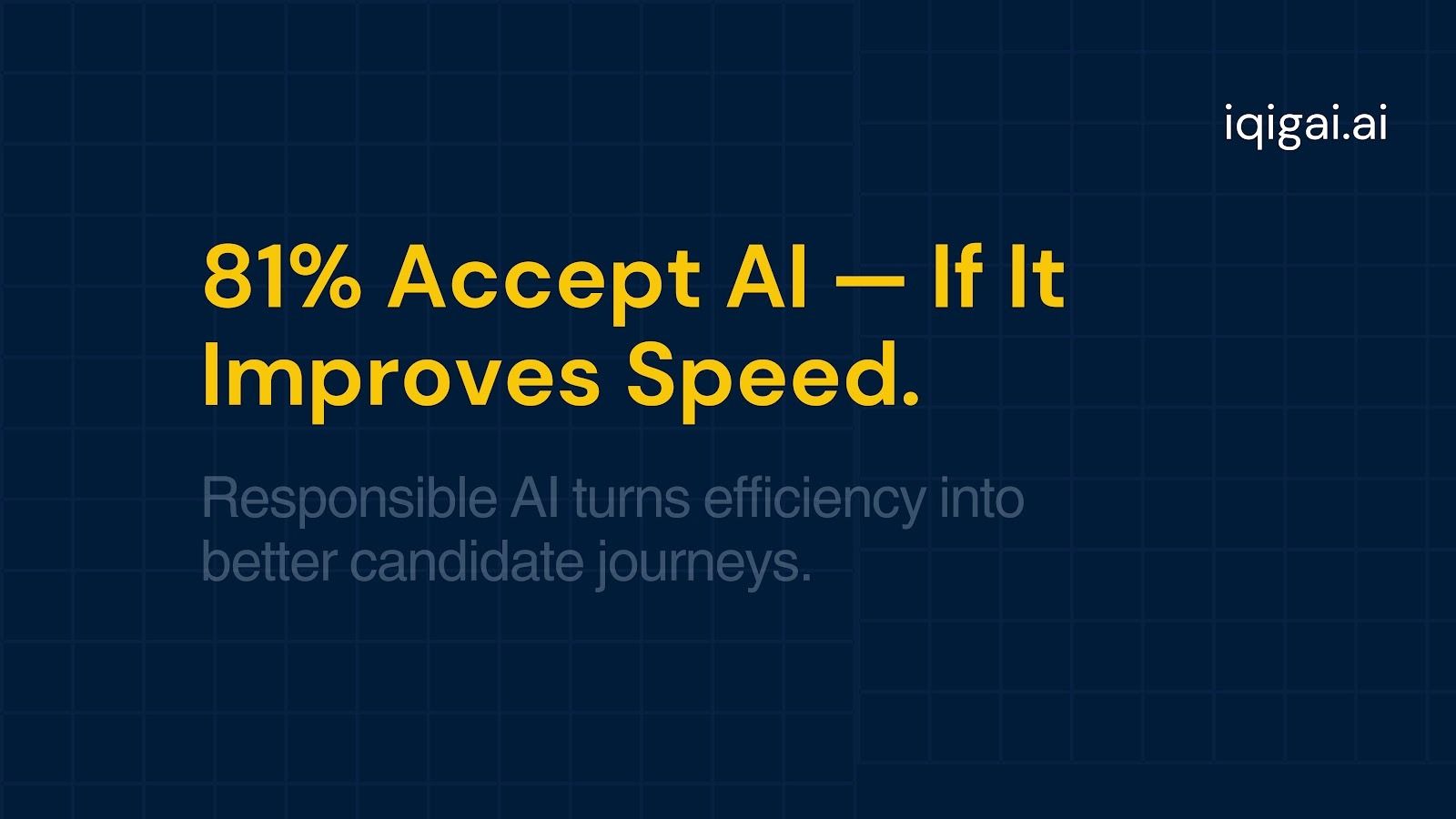
Candidate reactions are genuinely mixed, supported by findings on candidate experience and AI in hiring. 58% say they're comfortable interacting with chatbots in early hiring stages, and 81% will accept AI if it speeds up the process. When Unilever redesigned its hiring process with AI, it cut hiring time from four months to four weeks, and 80% of candidates reported a positive experience.
But implementation matters enormously. 56% of candidates believe no human ever sees their resume, and only 14% of tech workers trust AI-driven recruitment processes. When candidates feel like they're being evaluated by a black box with no human oversight or feedback, trust collapses.
The issue isn't AI itself; it's opacity. Thoughtful use of AI, like chatbots for status updates, automated scheduling, and faster communications, actually improves the experience. Recruitment chatbots handle 90% of candidate enquiries during early screening, reflecting trends in how AI chatbots are transforming recruitment, and Companies report a 50%+ uplift in perceived responsiveness, similar to findings on how chatbots improve hiring engagement.
Where AI damages experience is when it removes human touchpoints entirely, provides no feedback on rejections, or creates accessibility barriers. The ACLU filed a complaint against HireVue and Intuit for discriminating against a deaf applicant, highlighting that speech-to-text errors can reach up to 22% for some demographic groups.
Candidate experience isn't determined by whether you use AI, but how you use it. The winning formula is AI for speed, humans for judgment, and transparency throughout. Map your candidate journey and ensure every AI touchpoint includes full disclosure.
4. "AI Hiring Is Only for Large Enterprises"
This might have been true three years ago. But not anymore.
68% of small business owners now use AI, reflecting wider AI adoption trends among SMBs and future-of-work research, including those with just 10-100 employees. That's up from 47% in 2024—a 41% increase in a single year. Even more striking: 85-90% of companies using AI in hiring are small to mid-sized organizations, not large enterprises.
The gap between large and small businesses has nearly closed. In February 2024, large businesses used AI at 1.8 times the rate of small businesses. By August 2025, small businesses were at 8.8% adoption and large businesses at 10.5%. SMBs are now just 12-18 months behind enterprises in AI adoption, the fastest tech adoption cycle in modern business history.
Why are smaller companies adopting so quickly? Cloud-based SaaS tools have dramatically lowered cost and complexity barriers. More importantly, the ROI case is often stronger for SMBs than for enterprises. High-volume hiring with lean HR teams creates exactly the conditions where AI delivers immediate value. 66% of SMB owners now believe AI adoption is essential to stay competitive.
The value of AI scales with hiring complexity, not company size. If you're hiring for niche skills, high-growth roles, or managing high application volumes, AI reduces manual effort and shortens time-to-hire regardless of your headcount.
The barrier isn't cost or complexity anymore, but the speed of decision-making. Start with one high-pain point like resume screening for high-volume roles, or interview scheduling for distributed teams. Prove ROI in 90 days before expanding.
5. "Candidates Can Easily Game AI Systems"
With GenAI widely accessible, the major concern for hiring leaders is that candidates can easily manipulate screening systems through keyword stuffing or AI-generated applications. Candidate "gaming" isn't a novel concept. Exaggeration and strategic signaling have existed in hiring since the very first resume was written.
41% of job seekers self-report using hidden text tactics, and 78% admit to keyword stuffing resumes. But the actual disconnect is that only 1-10% of these attempts are actually detected by ATS platforms. Either the gaming attempts are ineffective, or they're slipping through unnoticed.
Modern AI hiring systems rely on contextual evaluation, similar to insights shared in how AI helps recruiters cut noise in hiring. They use natural language processing and contextual understanding rather than simple keyword counting. AI algorithms now detect and penalize obvious keyword stuffing, and platforms like Greenhouse, which processes 300 million resumes annually, report that only 1% of resumes contain white text manipulation attempts.
The larger strategic risk isn't candidates gaming AI. It's organizations over-indexing on any single signal, whether human or algorithmic. Mature hiring systems deliberately combine multiple data points. Gaming one element doesn't override the others. The candidates successfully "gaming" AI are often the ones who lack the underlying qualifications.
Robust hiring uses multiple signals, not blind automation. Audit your hiring funnel for single points of failure. If AI rejection equals final rejection with no other evaluation, you've built a brittle system vulnerable to both gaming and false negatives. Add work samples, phone screens, or skills tests as secondary verification. The defense against gaming isn't tighter algorithms but redundant validation.
6. "AI Alone Will Fix Diversity and Inclusion"
The assumption says that if you remove human subjectivity and add AI, you’ll get diverse outcomes automatically. It's optimistic but incomplete.
55% of companies using AI report more diverse new hires, and 61% of HR teams now use AI tools specifically for diversity hiring. But the Stanford and University of Washington studies show that AI can also worsen disparities when not designed with fairness as an explicit goal.
The dramatic variation in outcomes is because AI operationalizes whatever objectives you set. If your training data, evaluation metrics, or optimization targets reflect historical imbalances, the system will reproduce them. If you optimize for skills, anonymize demographic signals, and encode fairness constraints, you can improve diversity.
The difference isn't the tool. It's the governance. Companies achieving diversity gains through AI share common practices. They set explicit D&I targets before deployment, encode fairness constraints into models, run outcome-based audits quarterly, and measure downstream impact, including retention and promotion, not just hiring. Without explicit diversity goals, measurement frameworks, and accountability mechanisms, AI simply automates the status quo faster.
Treat diversity as a strategic goal, not a checkbox for tooling. Before deploying AI for diversity, define what success means with specific metrics. Baseline your current state by demographics. Set target improvements. Measure monthly. Adjust algorithms based on outcomes, not intentions. AI should be the execution layer for a broader DEI strategy, but not a substitute for leadership commitment and rigorous measurement.
7. "AI Can Autonomously Make Hiring Decisions"
A common belief is that AI-driven hiring leads to full automation, where algorithms make hiring decisions without any human involvement.
In practice, this is rarely the case. Only 31% of recruiters let AI make final hiring decisions, and 25% believe it's entirely unjust to leave decisions to AI. Most enterprises deliberately limit how much autonomy AI has, especially for roles with higher impact or risk.
The hesitation is intentional. Hiring decisions carry legal, ethical, and reputational accountability. Leaders are unwilling to delegate that responsibility entirely to algorithms. Concerns around explainability, compliance, and candidate trust reinforce the need for human oversight. Only 14% of tech workers trust AI-driven recruitment processes fully, and that trust deficit creates real business consequences when candidates opt out of your pipeline entirely.
AI is primarily used to support decisions like ranking candidates, flagging patterns, surfacing insights, rather than making final calls. 80% of SMBs using AI say it enhances their workforce rather than replacing it. The co-pilot model works: AI improves speed and consistency, while humans remain responsible for judgment, trade-offs, and outcomes.
The goal isn't autonomous hiring. It's better-informed human decisions at scale. Companies pursuing full automation are solving for the wrong problem. The value lies in augmentation, in multiplying the reach of your best recruiters by 10x rather than replacing them. Define clear boundaries for what AI recommends versus what humans decide. Hiring decisions are fundamentally prediction problems — an idea expanded in rethinking recruitment as a data-driven decision system. Humans make final calls on actual hires, especially for edge cases and high-impact roles. Every outcome should have a person's name on it, someone accountable when things go right or wrong.
8. "Implementing AI in Hiring Is Plug-and-Play"
The common assumption: buy the tool, integrate it, and outcomes improve automatically — but automation alone doesn’t guarantee better outcomes, a distinction explored further in automating hiring vs improving hiring. In reality, AI initiatives stall not because the technology fails, but because the operating model around it does.
Research from Gartner and McKinsey consistently shows that AI adoption challenges for HR leaders go beyond model accuracy. 42% of small businesses lack the resources or expertise to deploy AI successfully, 48% struggle to choose the right tools, and 46% have data privacy and security concerns.
Here's what typically happens: hiring data is fragmented, inconsistent, or poorly labeled. Recruiters distrust AI recommendations they can't explain. Hiring managers ignore outputs that conflict with intuition. As a result, organizations end up using AI in narrow, low-impact ways despite significant investment. The technology works fine—the adoption doesn't.
Successful AI hiring requires more than procurement. It demands clean data, clear decision rules, stakeholder buy-in, and ongoing governance. Companies achieving ROI treat AI as a capability to build, not a product to install. That means training recruiters and hiring managers, documenting decision processes, measuring outcomes, and iterating based on what works. Platforms like iqigai are designed around this capability-first approach, helping enterprises operationalize AI hiring through structured workflows, transparent decision logic, and human-in-the-loop oversight rather than treating AI as a plug-and-play feature.
Without clarity on how AI recommendations are generated and how they should be used in actual decisions, adoption remains superficial. You end up with expensive software that sits unused or underutilized because stakeholders don't trust it or don't know how to integrate it into their workflow.
Your AI hiring investment ROI correlates more with change management competence than model sophistication. The companies getting burned aren't the ones who chose the wrong vendor—they're the ones who underinvested in adoption. Budget formula for AI hiring: 40% for technology and licensing, 30% for data infrastructure and integration, 30% for training, change management, and governance. If you're only budgeting for the first line item, expect failure. This is an operational transformation, not a software purchase.
What Leaders Should Focus On Instead
If there's a pattern across these eight misconceptions, it's this: leaders expect AI to solve problems it was never designed to fix. AI doesn't eliminate bias. It scales whatever biases already exist in your decision-making. It doesn't replace judgment. It multiplies the moments where judgment matters. And it doesn't guarantee fairness. It executes on the goals you set, not the ones you meant to set.
The companies making AI work in hiring aren't the ones with the most sophisticated algorithms. They're the ones who understand that AI is an amplifier, not a solution. It makes good hiring practices faster and more consistent. It also makes bad practices faster and more damaging.
So what should you focus on? Three things matter more than your technology stack.
The question isn't whether to use AI in hiring. It's whether you're using it to amplify good judgment or automate bad decisions. Technology is table stakes. Strategy is the differentiator.