
Skills-Based Hiring vs Role-Based Hiring: What Candidates Need to Understand About Modern Recruitment
Thu, Jan 01, 1970
The Rules Have Changed, But Nobody Told You
If you have applied for jobs recently, you have probably noticed something quietly confusing about the process. One company asks for a specific degree and a minimum of five years in an identical role. Another asks you to complete a problem-solving assessment before you have even spoken to a recruiter. One interview feels like a career retrospective. Another feels like a live demonstration. The criteria seem to shift depending on who is hiring, and no one has handed you a guide to explain why.
This is not randomness. It is the result of two fundamentally different hiring philosophies operating in the same job market at the same time. One is built around the job title and the credentials attached to it. The other is built around what you can actually do. Both are real. Both are active. And depending on which one you are walking into, the way you need to prepare, present yourself, and interpret feedback is meaningfully different.
The goal of this post is straightforward: to give you a clear, honest understanding of both models, how they differ in practice, and what each one asks of you as a candidate. Not as abstract theory, but as something practically useful, the next time you read a job description and try to figure out what a company is actually looking for.
What Role-Based Hiring Actually Means, And Why It Dominated For So Long
Role-based hiring is the model most of us grew up understanding as simply "how hiring works." A company has an open position. That position has a title. The title comes attached to a set of expected qualifications: a relevant degree, a certain number of years of experience, possibly a credential or two, and a history of employment at companies that signal the right kind of background. Your resume is read as a record of whether you fit that profile. If it does, you move forward. If it doesn't, you don't.
The underlying logic is one of proxies. A degree from a recognised institution signals a certain level of intellectual foundation and discipline. Years of experience in a specific role signal familiarity with its demands. A recognisable employer on your resume signals that someone, at some point, already vetted you. None of these things directly measure your ability to perform the job, but they serve as reasonable shortcuts in a world where assessing actual ability at scale is difficult and time-consuming.
For a long stretch of the twentieth century, this model worked well enough. Organisations were relatively stable. Job descriptions changed slowly. The skills required for a role in 1995 were largely the same skills required for that role in 2005. Credentials were a reasonable signal of preparation because the work itself was consistent enough for that signal to hold.
It is also worth being direct about something: this model is not obsolete. In regulated industries such as law, medicine, aviation, and certain areas of finance, formal qualifications are not arbitrary gatekeeping. They are legally required, professionally mandated, or both. If you are pursuing a career in one of those fields, credentials are not optional, and treating them as such would be a mistake. Role-based hiring, in those contexts, exists for legitimate reasons.
What Skills-Based Hiring Actually Means, And What It Asks of You
Skills-based hiring starts from a different question. Instead of asking what qualifications a candidate holds, it asks what the role actually requires in terms of competency, and then looks for evidence that the candidate possesses those competencies. The title becomes less important. The degree becomes less important. What becomes important is whether you can demonstrate, concretely and specifically, that you are capable of doing the work.
In practice, this changes the structure of the hiring process from the very first touchpoint. Job descriptions in a skills-first organisation tend to be written around capabilities and expected outcomes that reflect the skills employers prioritise. You might see language about problem-solving, cross-functional collaboration, the ability to work with ambiguous data, or specific technical skills, where you would previously have seen "bachelor's degree required" and "minimum seven years of experience." The assessment of whether you meet the bar shifts from a resume scan to something more active: a work sample, a case study, a structured competency interview, or a skills assessment designed to surface your actual capability.
This matters for candidates in a very specific way. In a skills-based process, the evidence you need to present is different. Your job title at your last employer carries less weight. The name of the company you worked for carries less weight. What carries weight is your ability to articulate, clearly and specifically, what you did, how you did it, and what it produced. The currency of skills-based hiring is demonstrated competency, and that is something you need to prepare for deliberately, not assume will be inferred from your CV.
By 2024, a significant majority of employers globally had adopted some form of skills-based hiring, and research, including LinkedIn Global Talent Trends research, consistently shows that most candidates, when given the choice, prefer this model. That preference is understandable. A process that evaluates what you can do rather than where you have been is, in principle, a fairer and more accurate one. But preference and preparedness are different things, and many candidates find themselves unprepared for what skills-based hiring actually asks of them in practice.
The Core Differences, Side by Side
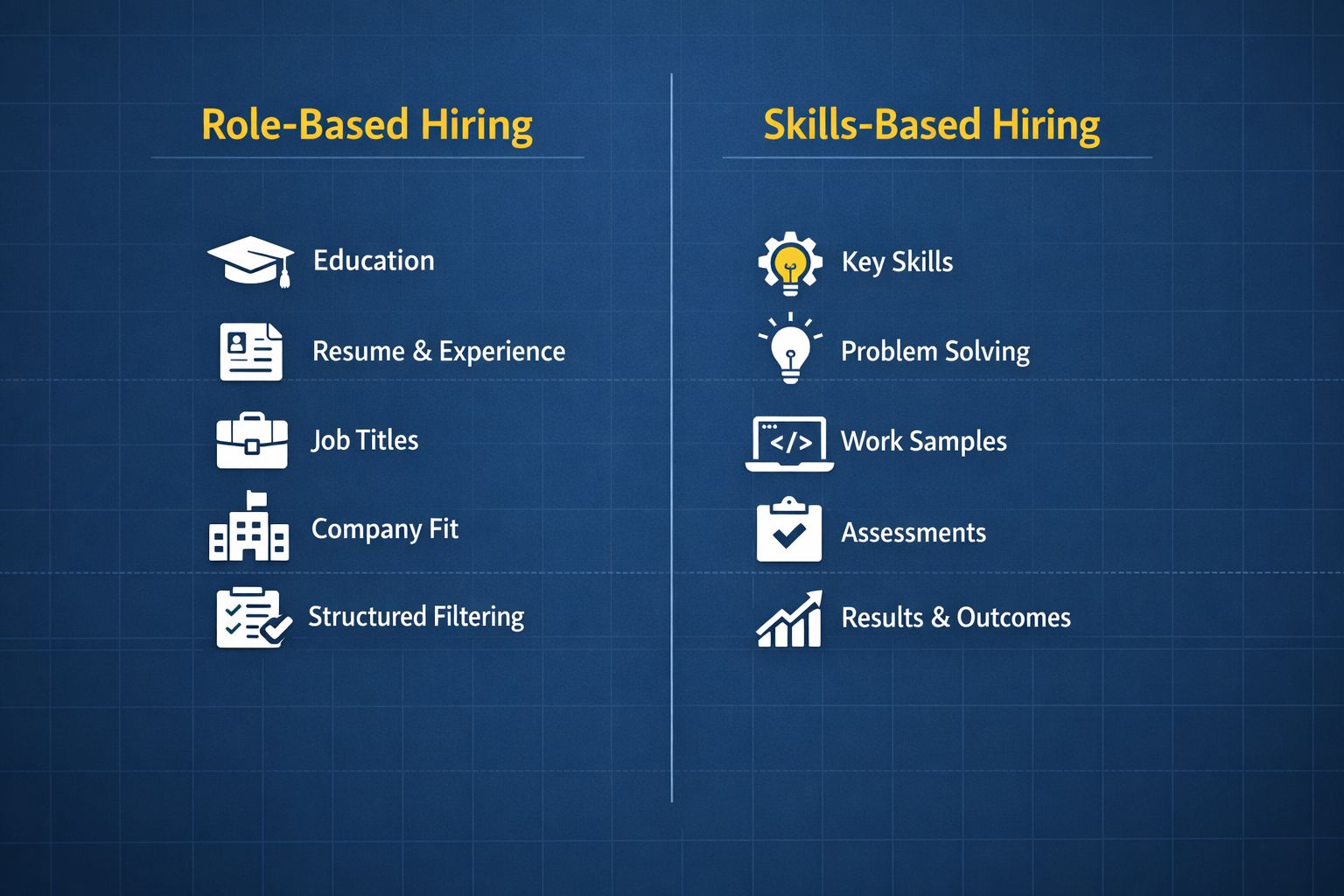
Understanding these two models in the abstract is useful. Understanding how they differ at each specific stage of the process you will actually go through is more useful. Here is where the distinction becomes concrete.
What the job description signals.
A role-based job description leads with the container: the title, the required qualifications, and the years of experience. Read one, and you will know fairly quickly whether your resume technically qualifies. A skills-based job description leads with the work: the outcomes expected, the problems the role will solve, and the competencies that will be tested. Read one, and you will need to ask yourself a different question, not whether your background matches, but whether your capabilities do. As of 2024, more than half of job postings in the United States carried no formal education requirement, a figure that has been rising steadily for several years. When you see a posting built around capability language rather than credential language, you are almost certainly reading a skills-first employer.
How you will be screened.
In role-based hiring, the initial screen is largely passive from your perspective. An applicant tracking system or a recruiter reviews your resume against a checklist. If your title, degree, and years of experience meet the threshold, you advance. In skills-based hiring, the screen is often active. You may be asked to complete an assessment, submit a work sample, or solve a problem before a human being has read a single line of your resume. This is not unusual or unreasonable. It is the mechanism by which skills-first organisations surface candidates who would be filtered out by a traditional credential screen. Research shows that a substantial majority of hiring managers in skills-based organisations will advance a candidate with strong assessment results even if their years of experience fall short of the stated requirement, and many will do the same for candidates who do not meet minimum education requirements. That is a meaningful departure from how role-based screening works.
What the interview tests.
A role-based interview often functions as a verification exercise. The interviewer is confirming what your resume already suggested: your familiarity with the industry, your history at relevant companies, and your understanding of the role as it has traditionally been defined. A skills-based interview is structured differently. It is designed to generate evidence. You will be asked to describe specific situations, explain the decisions you made, and articulate the outcomes that followed. The questions are behavioural and situational precisely because the interviewer is not trying to confirm your background. They are trying to assess your competency. These are different conversations, and they require different preparation.
How your career trajectory is read.
This is one of the most practically significant differences for a wide range of candidates. Role-based hiring rewards linearity. A clear, unbroken progression through roles with matching titles in the same industry is the ideal profile. Career gaps, lateral moves, industry pivots, or unconventional routes are treated as deviations from that ideal, and they can work against you even if your actual capability is strong. Skills-based hiring is structurally more forgiving of non-linearity, because the question is not whether your path was conventional but whether you have accumulated the competencies the role requires. If you have a varied background, or gaps you feel self-conscious about, or experience in an adjacent field rather than the exact one being hired for, a skills-first process is meaningfully more likely to give you a fair hearing.
What rejection usually means.
This is something candidates rarely think about but should. In a role-based process, rejection at the screening stage most often means a credential mismatch. Your degree, title, or years of experience did not meet the threshold. That tells you something specific: either you need to build more of a particular type of credential, or you need to find employers with different thresholds. In a skills-based process, rejection more commonly reflects a gap between the competency you demonstrated, something many job seekers experience when they don't understand why smart candidates keep getting rejected in modern hiring systems. That also tells you something specific, and something actionable: not that you are unqualified in a broad sense, but that a particular capability needs development or that your ability to evidence it needs work. The two types of rejection point you toward different responses.
The same candidate, two different processes.
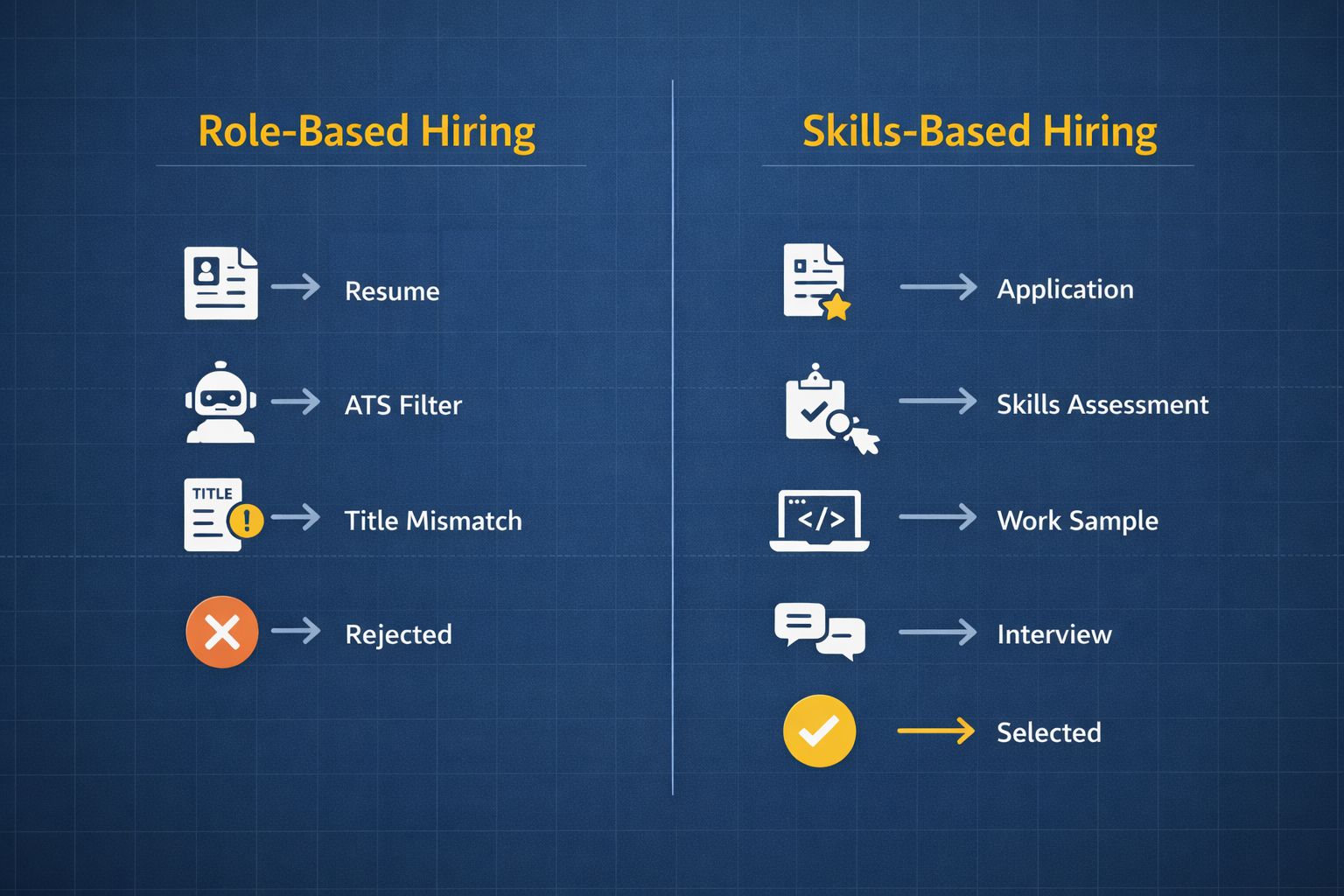
To make this concrete, consider a mid-career data analyst with three years of experience, a portfolio of projects, and a background that does not follow a perfectly linear path. She applies to two companies advertising the same role at the same level.
At the first company, the job description lists a degree requirement and asks for a minimum of four years in an identical title. Her resume is filtered at the ATS stage because her years of experience fall one year short, and her previous title, while functionally identical, uses different wording. She never speaks to a recruiter. The process has no mechanism to surface what she can actually do.
At the second company, the job description lists the core competencies the role requires: analytical thinking, the ability to work with messy datasets, and clear communication of findings to non-technical stakeholders. There is no degree requirement and no minimum title. She is asked to complete a short take-home task before her first recruiter call. Her work is strong. The recruiter's call focuses on a recent project, the decisions she made, and the outcome it produced. She advances to a structured interview where she is asked behavioural questions mapped to specific competencies. Her non-linear background is neither a liability nor an obstacle. What is assessed is what she demonstrated.
Same candidate. Same role. Two entirely different outcomes, driven entirely by which model the employer is operating under. This is not an edge case. It is the daily reality of the current job market, and it is why understanding the difference between these two models is not an academic exercise.
The Grey Zone: Why You Will Often Encounter Both at Once
It would be convenient if every company sat clearly on one side of this divide, but that is not the reality you will encounter. Most hiring processes exist somewhere on a spectrum between the two models, and many sit in an uncomfortable middle ground where the language of skills-based hiring is present, but the infrastructure to support it is not.
Research from Harvard and Burning Glass found that roughly 45% of firms that claim to have removed degree requirements show no meaningful change in actual hiring outcomes. The credential requirement disappeared from the job description, but the mindset that placed value on it did not disappear from the interview room. This is not necessarily cynical on the part of those organisations. It often reflects a genuine intention to shift that has not yet been matched by the internal training, structured assessment tools, and competency frameworks required to make the shift real. But for you as a candidate, the distinction matters because it affects how you should read the signals you receive.
A useful practical habit: pay attention to the full arc of the process, not just the job description. If a posting uses capability language but every interview question is about your educational background and previous employer names, you are in a role-based process that has adopted skills-based vocabulary. If the process includes a structured assessment, behavioural interviews with consistent questions across candidates, and feedback framed around specific competencies, you are genuinely in a skills-first process. Senior roles, even at otherwise progressive organisations, will often still weigh industry pedigree and network heavily. Regulated roles will retain hard qualification requirements regardless of what the broader market is doing. Neither of these is a failure of the system. They are characteristics of specific contexts that are worth knowing about in advance.
The practical conclusion is this: do not assume. Prepare for both models until the process itself gives you enough information to know which one you are actually in.
What This Means for How You Present Yourself
Understanding the difference between these two models is only useful if it changes something about how you approach your job search. Here is what it should change.=
Audit your resume for skills language.
The standard resume is an artefact of role-based hiring. It is organised around job titles, employer names, and lists of responsibilities. In a skills-based process, that architecture works against you, because it presents the proxies rather than the evidence. Go through your experience and ask yourself, for each role: what did I actually produce, what competencies did I use to produce it, and how would I describe that to someone who has never heard of my previous employer and does not recognise my job title? The answers to those questions are what should drive the language on your resume in a skills-first application.
Mirror the language of the job description.
This is not about manipulation. It is about communication. If a job description is built around specific competencies and your resume uses entirely different vocabulary to describe the same capabilities, you are creating unnecessary distance between what they are looking for and what you are offering. Read the posting carefully, identify the competency language it uses, and make sure your application reflects that language in the context of your actual experience.
Take assessments seriously, and ask intelligent questions about them.
In a skills-based process, a pre-employment assessment is often your first and most important opportunity to demonstrate capability. Many candidates treat it as an administrative step before the real process begins. That is a mistake. Treat it as your primary audition. It is also entirely reasonable, and in fact a sign of good judgment, to ask what the assessment is evaluating and how responses are scored. A well-designed skills-based process will have clear, considered answers to those questions. If the organisation cannot tell you what a test is measuring or how it will be used, that is useful information about the rigour of their process and worth factoring into your own assessment of the opportunity.
Do not self-eliminate on title mismatch.
One of the most common and costly mistakes candidates make in a skills-first job market is declining to apply for roles where their previous title does not directly match the advertised one. If the role description, when you read it carefully, describes work you have demonstrably done using competencies you demonstrably have, the title gap is far less disqualifying than it might feel. Skills-first organisations are specifically structured to surface candidates who would be overlooked by a title-match screen. Use that.
Build a visible record of your capabilities.
In a skills-based process, evidence outside your employment history carries real weight. Certifications, structured learning, side projects, contributed work, and demonstrable outcomes from any context, professional or otherwise, can all serve as evidence of competency. A candidate who can point to a specific project, explain the skills it required, and describe what it produced is in a meaningfully stronger position than one who can only reference job titles held at previous employers.
Where Recruitment Is Heading
According to Deloitte’s Global Human Capital Trends research, the structural direction of hiring is not ambiguous. A large and growing proportion of employers now consider skills-based evaluation more predictive of job performance than resume screening. Organisations are investing in competency frameworks, building assessment infrastructure, and increasingly using technology to map candidate capabilities to role requirements, a shift highlighted in future of work research.
The premium on being able to demonstrate, articulate, and evidence your capabilities will continue to increase as skills demand continues to rise. The credential as a reliable shortcut to employability is losing ground, according to global workforce skills research. not uniformly, not overnight, but steadily and in a direction that is unlikely to reverse. This is, on balance, good news for people whose abilities have historically been underrepresented by their credentials. It asks more of you in terms of preparation and self-awareness, but it gives you more genuine pathways into roles that a purely credential-based system would have closed off.
Platforms built on skills-matching infrastructure, like iqigai, are part of how this shift is being operationalised at scale, connecting candidates to opportunities based on actual competency alignment rather than keyword proximity or credential matching. The technology is maturing in step with the hiring philosophy, and candidates who understand both will be better positioned to use them effectively.
Know the Game Before You Play It
The candidates who navigate this moment in the job market well are not necessarily the most experienced or the most credentialed. They are the ones who understand what is being evaluated and make sure the evidence they present speaks directly to that criterion.
If you are in a role-based process, your credentials, your titles, and your professional pedigree are the currency. Present them clearly and let them do the work. If you are in a skills-based process, demonstrated competency is the currency. Your ability to describe specifically what you did, how you did it, and what it produced is what will determine how far you go. If you are in a hybrid process, which is most likely, prepare for both until you know which one is actually driving the decisions.
The hiring landscape has changed. Understanding how it has changed and adjusting how you present yourself accordingly is not a small thing. It is the difference between preparing for the right interview and preparing for the wrong one.