
AI Resume Screening Explained: What Actually Happens After You Click Apply
Tue, Mar 10, 2026
There is a moment, right after you submit a job application, where everything goes quiet. No confirmation of whether your experience registered. No signal of whether your resume reached anyone. Just a submission timestamp and an automated acknowledgment.
What fills that silence is software. And the gap between understanding it and fearing it can be the difference between landing an interview and wondering why you never heard back.
Here is what most career advice gets wrong about this: it leads with alarm. If you've experienced applications disappearing into silence, it's often part of what candidates describe as the resume black hole. You have probably seen the claim that 75% of resumes are rejected by automated systems before a human ever reads them. That number has circulated for over a decade, and it has been traced back to a defunct recruiting-services company with no disclosed methodology behind it. Repeating it without scrutiny does candidates no favors.
What the evidence actually shows is more nuanced and more useful. A Harvard Business School study found that more than 90% of companies use technology to rank and filter candidates, which is meaningfully different from automated rejection. Separately, 88% of employers believe they are losing qualified candidates who are screened out, not because they lack the skills, but because their resumes are not formatted or written in a way the system can read correctly.
That is the real problem. Not a system designed against you. A translation gap between how you wrote your resume and how the system reads it. And unlike a qualification gap, it is fixable.
Most mid-to-large companies today use Applicant Tracking Systems to manage applications at scale. The software reads first, ranks, and recruiters start from the top. The system is not judging your worth. It is performing a structured comparison between what your resume says and what the job description asks for. Understanding exactly how that comparison works is where the leverage is.
What the software actually does with your resume
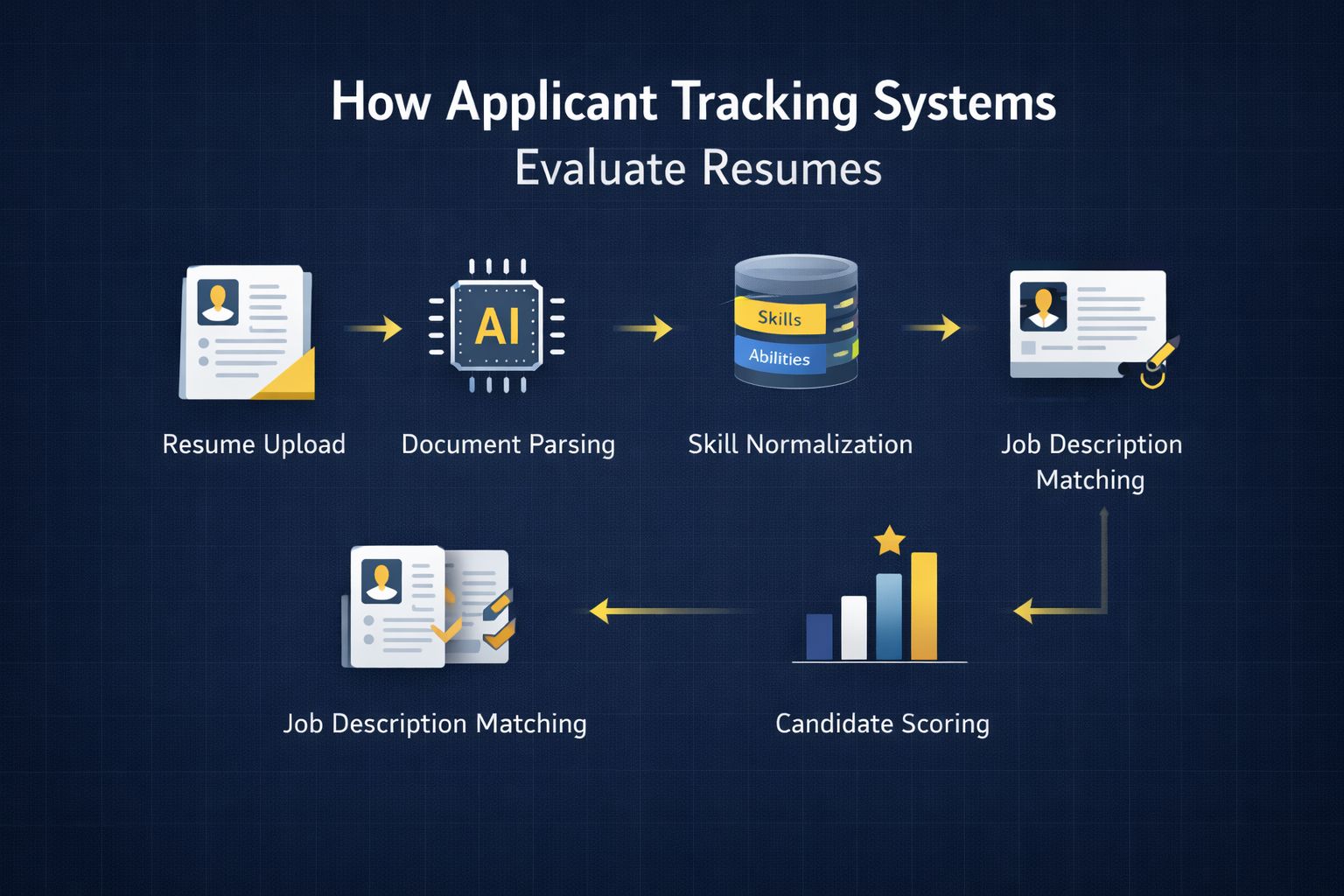
Corporate job postings receive an average of 250 applications. Nearly 98 percent of Fortune 500 companies use an ATS to manage that volume. Understanding what the software does with your resume across each step is where the practical leverage starts.
Step 1: Document ingestion and parsing
The moment your file uploads, the system converts it into plain text and extracts structured fields: your name, contact details, job titles, employment dates, education, and skills. This is a mechanical process. The parser is not reading your resume the way a human does. It is scanning for recognizable patterns.
This is why format matters more than most candidates realize. Multi-column layouts, skills presented as visual icons or graphics, text embedded in images, or decorative resume templates with text boxes can all cause the parser to misread or skip sections entirely. A candidate with eight years of exactly the right experience can score poorly simply because their skills were placed in an image that the system could not read.
The fix is straightforward. Use a single-column layout. Keep everything in plain, readable text. Save as PDF or DOCX. Avoid any template that prioritizes visual complexity over clean structure.
Step 2: Normalization and mapping
Once extracted, your words are standardized. The system maps abbreviations and variants to recognized forms. "JS" becomes "JavaScript." "P&L ownership" gets mapped to financial management signals. Vendors maintain skill taxonomies specifically, so candidates who describe the same competency differently can still be compared.
This normalization works reasonably well, but it is not perfect. If you use highly internal or company-specific language for a skill that has a standard industry name, the match may not register cleanly. The safer choice is to use the language the job description uses, particularly for must-have technical skills and certifications. If the JD says "AWS Certified Solutions Architect," use that exact phrase if you hold it.
Step 3: Job description modeling
The system parses the job posting as well. It separates required qualifications from preferred ones, identifies seniority signals, and models the role as a set of weighted attributes. What this means practically is that not every word in the JD carries equal weight. The required skills listed early in a posting are scored more heavily than the preferred-but-not-essential items near the bottom.
When you are reviewing a JD before applying, read it as the system will. Identify the three to five non-negotiable skills. Make sure each one appears in your resume with context, not just as a listed term.
Step 4: Scoring and ranking
The system computes a fit score based on overlap across hard skills, job titles, tenure signals, certifications, location, and other structured data points. Candidates are ranked. Recruiters typically work from the highest scores down.
This is where the gap between a strong candidate and a visible one gets created. Two people with equivalent experience but different resume structures can receive meaningfully different scores. The one whose resume was formatted for human aesthetics may rank lower than the one whose resume was formatted for machine readability, even if the former is the stronger hire.
Step 5: The human review threshold
Some companies use the score as a soft recommendation. Others set hard cut offs that automatically exclude anyone below a certain rank. If you applied and heard nothing, there is a real possibility your resume did not clear the threshold for human review, not because you lacked the skills, but because the format or language did not communicate them clearly to the system.
That is where the post-submit silence usually comes from. Not indifference. A score that did not clear a threshold your resume was capable of clearing.
What the software weighs most heavily
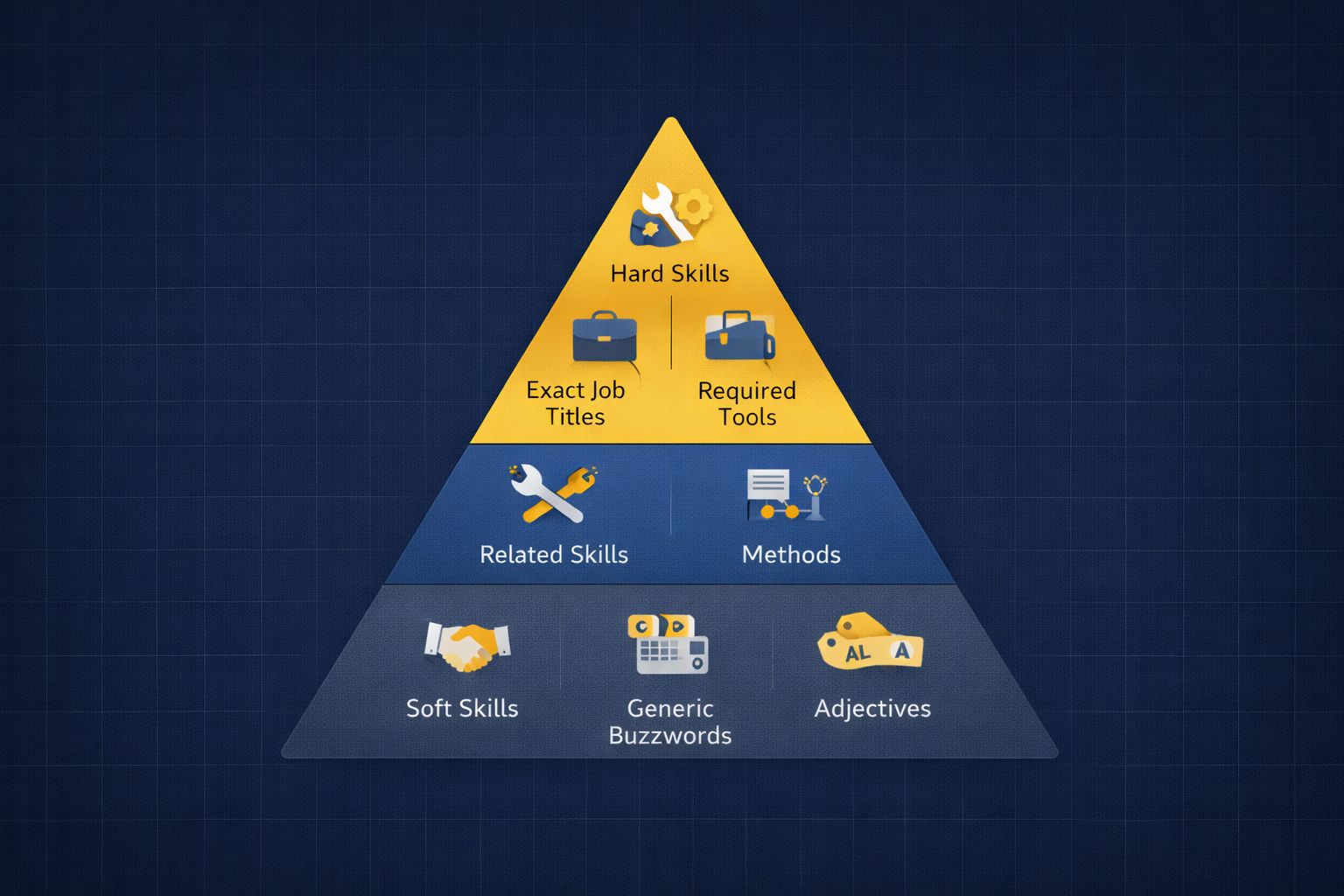
Not everything on your resume registers with equal weight. Must-have skills, exact job titles, tools, and certifications sit at the top of the scoring hierarchy. Related methods and secondary skills sit in the middle. Generic soft skills and industry jargon carry the least weight of all.
This is where many candidates inadvertently work against themselves. They spend the most time on the parts of their resume that score lowest algorithmically, like personal summary, leadership narrative, and carefully chosen adjectives. These elements matter, but they matter to the human reviewer, not to the system that decides whether a human reviewer ever sees the resume at all.
The practical implication is straightforward. Before you refine your summary, make sure your must-haves are accounted for. Go through the job description and identify the skills, tools, and certifications listed in the requirements section, particularly anything repeated more than once. Those are the signals the system is actively looking for. Keywords placed in your professional summary and work experience sections carry the most scoring weight, so that is where your must-have terms belong, embedded in context, not just listed.
Once those are in place, your summary and narrative framing will do exactly what they are meant to do: speak to the person who is already looking at your resume because the system decided you were worth their time.
How to make your resume readable to both machines and people
The goal is not to optimize for the algorithm at the expense of the human reader. The goal is to make your resume clear, structured, and honest in a way that serves both. These are not competing objectives.
Your title is the first signal the system confirms
Place a clear role title directly under your name. It is the first field a parser confirms and one of the first things a recruiter registers. If your current or previous title is company-specific and unconventional, add the conventional equivalent in parentheses. For example: Senior Strategy Lead (Product Strategy Manager). This serves both audiences without misrepresenting anything.
Your skills section needs to be plain text, not a visual
Create a plain-text skills section. List technical skills, tools, platforms, and certifications using commas, not icons or visual badges. Mirror the exact terminology the JD uses for required skills. Do not inflate the list with skills you cannot speak to in an interview. A short, accurate, well-matched skills section outperforms a padded one every time.
Your bullets are doing more work than you realize
This is where most candidates leave significant value on the table. Research from Job scan found that 58 percent of recruiters say measurable achievements are what make a resume stand out most. Numbers are machine-friendly because they are structured data points that the system can register. They are persuasive to humans because they replace assertion with evidence.
Lead with the result where possible, then the action, then the metric. "Increased enterprise retention 15 percent year-over-year by launching a churn prediction model and targeted outreach program" is more useful to both audiences than "Responsible for retention initiatives." You do not need a number on every bullet. But aim for most of them, and prioritize the roles most relevant to the position you are applying for.
If you genuinely do not have hard numbers for a particular achievement, use conservative estimates, scope indicators, or relative impact. "Led onboarding redesign for a team of 40, reducing ramp time by approximately three weeks" is stronger than leaving the achievement unquantified.
Employment dates need to be fully readable
Use the month and year for every role. "Jun 2019 to Mar 2023" is unambiguous. Years can only create gaps that the system interprets as shorter tenure than it was. If there is a significant break in your timeline, a single brief note is enough: Career break, 2021 to 2022. You do not owe an elaborate explanation. Naming it cleanly is always better than leaving it for someone to wonder about.
Format and length: simple beats clever
Two pages for senior roles. One page for early careers, where possible. Clean, standard fonts. Single column. No tables, text boxes, or embedded graphics. These are not aesthetic preferences. They are structural decisions based on what parsers handle reliably. A beautifully designed resume that a parser cannot read is, for the purposes of this process, an invisible one.
A quick diagnostic if your applications are going unanswered
If you have been applying consistently and hearing nothing back, it is worth pausing before sending more applications. Submitting a resume that has a structural problem repeatedly does not improve your odds. It compounds them.
There are two distinct problems that produce silence, and they require different fixes.
The first is a parsing failure. Your resume may contain formatting that the system cannot read, which means your skills and experience are not registering at all. To check for this, copy your entire resume and paste it into a plain-text editor. Read what comes out. If sections are missing, if bullets have vanished, or if your skills appear garbled, the original file has a structural problem. Rebuild it using a clean, single-column Word template or a simple PDF, and the issue resolves.
The second is a keyword mismatch. Your resume may be parsing perfectly, but not reflecting the language of the job description closely enough to score well. If the plain-text test looks clean, go back to the job description and compare it directly against your resume. Identify the three to five required skills listed in the posting and check whether each one appears in your resume with context. If they are absent or described in a different language, that is likely where the gap is.
Both problems are fixable within a single revision. Address format first, then language alignment. Once those two things are in order, you are no longer sending the same resume repeatedly. You are sending a meaningfully different one.
When reaching a human directly is possible
Automation handles volume. It does not handle relationships. Many common assumptions about how AI participates in hiring are also misunderstood. And if there is any path to a human touchpoint alongside your application, it is worth taking.
Many candidates hesitate here. Reaching out to a recruiter or hiring manager directly can feel presumptuous, like jumping a queue you were not supposed to know existed. It is not. Recruiters are paid to find good candidates. Making it easier for them to see that you are one is not an imposition. It is professional courtesy.
If a referral is available to you, use it. A New York Fed study found that referred applicants are 7.3 percentage points more likely to be interviewed and 14 percentage points more likely to receive an offer once interviewed, compared to candidates who applied through job boards. If someone in your network works at the company, ask them to submit the referral through the company portal and follow it with a short note that highlights two direct points of alignment to the job description. The more specific the referral, the more useful it is to the recruiter receiving it.
If you do not have a referral but can identify the recruiter or hiring manager on LinkedIn, a short, factual outreach message is appropriate. Keep it under 60 words. Do not lead with enthusiasm about the company. Lead with relevance. Point to two explicit matches between your background and the role, and make the connection easy for them to see. The goal is to make their review easier by doing some of the matching work for them, so that opening your application feels worthwhile rather than like adding to an already long list.
One message, sent once, with a specific point of relevance. That is all it takes to move from an anonymous application to a name a recruiter recognizes when they open your resume.
What you are working with, and what you can change
The hiring system at this scale is imperfect. That is worth saying plainly. Qualified candidates are sometimes filtered out by formatting issues, keyword mismatches, or parsing failures that have nothing to do with their ability to do the job. If that has happened to you, it does not reflect the quality of your experience. It reflects a structural gap between how you presented it and how the system read it.
That gap is closeable. A single-column format, terminology that mirrors the job description, quantified bullets, and a clean skills section will move most candidates from invisible to reviewed. These are not tricks. They are the minimum conditions for your actual experience to be seen clearly.
But it is also worth knowing that the industry is beginning to move beyond keyword-based screening altogether. Platforms like iqigai are built on the premise that demonstrated ability is a far stronger hiring signal than resume formatting. Rather than ranking candidates by keyword overlap, iqigai's matching engine builds a 360-degree candidate profile through domain-specific assessments, skills benchmarking, and behavioral signals. The resume becomes one input among many rather than the filter that decides everything.
That shift matters for candidates. It means that the constraints described in this piece, the parsing rules, the title hygiene, and the keyword mirroring are features of where most hiring infrastructure currently sits, not permanent conditions of how hiring has to work.
For now, the practical steps in this piece will serve you well. And when you encounter a process designed to evaluate what you can actually do rather than how well your resume was formatted, you will know the difference immediately.